COPSAC COPSAC COPSAC COPSAC
  • About COPSAC
    • About
    • Organization Diagram
    • Board of Directors
    • Research team
    • Location
    • Funding
    • Logo
    • Open positions
  • COPSAC cohorts
    • COPSAC2000 cohort
    • COPSAC2010 cohort
    • COPSACSEVERE cohort
    • COPSACACUTE cohort
    • COPSACDailyGutcohort
    • Methods
    • Data overview
      • COPSAC2000 Clinic
      • COPSAC2000 Exposures
      • COPSAC2000 Omics
      • COPSAC2000 Biobank
      • COPSAC2010 Clinic
      • COPSAC2010 Exposures
      • COPSAC2010 Omics
      • COPSAC2010 Biobank
  • Dissemination
    • Theses
    • Literature for parents
  • Research Projects
    • RestoreGut
    • COPSYCH Research Alliance
    • HEDIMED Consortium
    • EDIAQI Consortium
    • EAGLE Consortium
    • EarlyVir
  • Strategy
  • ‌

COPSAC DailyGut cohort

  • COPSAC2000 cohort
  • COPSAC2010 cohort
  • Biobank Inventory
  • COPSAC2010 Environmental exposures
  • COPSAC2000 Environmental exposures
  • COPSAC2010 Biobank
  • COPSAC2000 Biobank
  • COPSAC2000 Clinic
  • COPSAC2010 Clinic
  • COPSAC2010 Omics
  • COPSAC2000 Omics
  • COPSAC2000 Biomarkers
  • COPSAC2010 Biomarkers
  • COPSAC severe cohort
  • COPSAC acute cohort
  • COPSAC DailyGut cohort
Home Home COPSAC cohorts COPSAC DailyGut cohort

COPSACDAILYGUT Cohort

The infant gut microbiome develops rapidly from birth in a dynamic succession of bacterial species adapting to each other and the gut environment. Data from the COPSAC cohorts, among others, have shown how important the maturation of the gut microbiome is for health throughout childhood, in particular for the risk of childhood asthma. But we still are only scratching the surface when it comes to understanding how this beautifully orchestrated progression of cooperating microbes develops over the course of infancy.

In the DailyGut cohort, 12 pioneering families have collected daily stool samples from their infants, from the day of birth until their first birthday. This unique set comprises hundreds of samples per child, allowing us to understand the microbiome development at a much finer scale than was previously possible. The daily infant samples is supported by samples taken from the mother, father, any siblings or pets, and the child’s home environment. In addition, a detailed registration of exposures and introduction of new foods was taken by the parents.
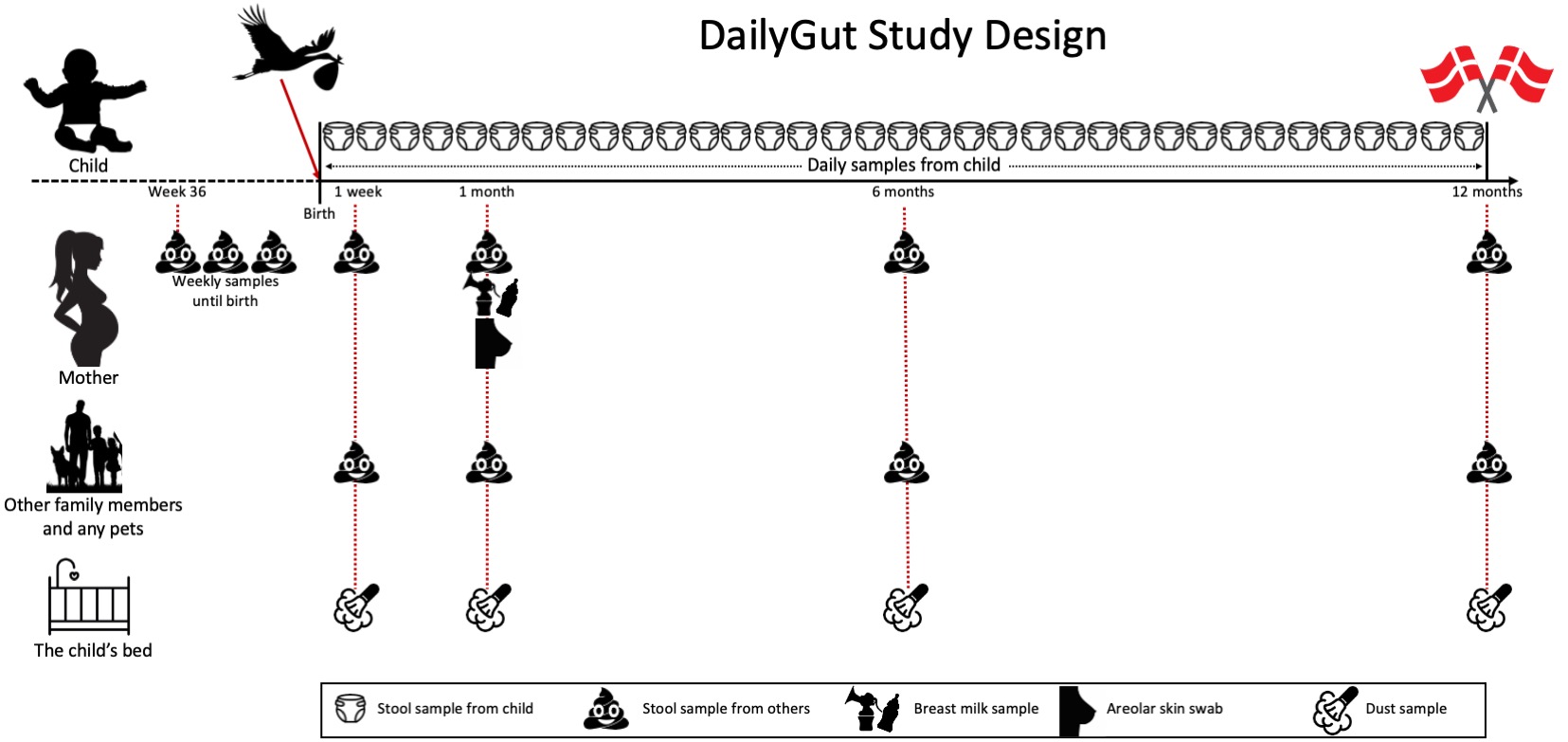
The figure shows an overview of the samples collected from the children, families, and home environment.

The almost 3500 samples are currently being examined using DNA sequencing, and the resulting data is being analyzed. We hope to improve our understanding of the establishment of the infant gut microbiome to better understand how we can support its development and positive effects on child health, perhaps even avoiding diseases like asthma altogether.

The DailyGut cohort study is supported by The Independent Research Fund Denmark and The Novo Nordisk Foundation.

For more information, please contact
Prof. Jakob Stokholm and
Asc. Prof. Jonathan Thorsen


CONTACT

COPSAC
Copenhagen Prospective Studies on Asthma in Childhood
Copenhagen University Hospital, Herlev-Gentofte
phone +45 3867 7360
contact@copsac.com
COPSAC • Copenhagen University Hospital, Herlev-Gentofte • Denmark © 2023
  • About COPSAC
    • About
    • Organization Diagram
    • Board of Directors
    • Research team
    • Location
    • Funding
    • Logo
    • Open positions
  • COPSAC cohorts
    • COPSAC2000 cohort
    • COPSAC2010 cohort
    • COPSACSEVERE cohort
    • COPSACACUTE cohort
    • COPSACDailyGutcohort
    • Methods
    • Data overview
      • COPSAC2000 Clinic
      • COPSAC2000 Exposures
      • COPSAC2000 Omics
      • COPSAC2000 Biobank
      • COPSAC2010 Clinic
      • COPSAC2010 Exposures
      • COPSAC2010 Omics
      • COPSAC2010 Biobank
  • Dissemination
    • Theses
    • Literature for parents
  • Research Projects
    • RestoreGut
    • COPSYCH Research Alliance
    • HEDIMED Consortium
    • EDIAQI Consortium
    • EAGLE Consortium
    • EarlyVir
  • Strategy
  • ‌
COPSAC